
Toothpick
2018
I don’t know if there’s anything I like about my body.
I don’t know if there’s anything I like about bodies in general.
It’s because my thoughts are always fixated on the parts I don’t like or want on my body.
body image, womanhood
One of the Guys
2019I’m a girl,
And I have two brothers.
I’ve always been told that I’m a “reckless” person.
But like I said,
I’m a girl who was brought up around two brothers.
What was I supposed to be like, then?
There was obviously a chance I’d turn out this way.
Hormonal Imbalances
2019
I got my period when I was 11.
Mama was understanding.
I have older sisters so I knew it was going to happen.
The first time I got it,
I told my sister and she lent me a pad,
And mama was happy when she found out that I got it early.
I Don’t Understand a Thing
2014I didn’t know a thing about periods.
When I asked, all I got was its definition from the dictionary.
“Menstruation is a physiological change that the female body goes through during puberty if the egg isn’t fertilized.”
I didn’t understand a word.
1000 FAQ for Women
2019I never feel shy asking him about anything.
He never turns me away.
“Let’s search for the answer together,” he’d always tell me.
Baba is amazing when it comes to respecting women.
Blanket
2012I’m not a woman, right?
I’m no longer a woman, am I?
How can I be a woman,
If I don’t get my period every month?
A little thing was gone,
And with it a lot of blood was lost.
My secrets were gone with it.
Where will I keep my secrets now?
Older and Lovelier
2019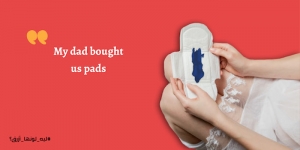
My parents have always been aware and informed, thank God.
One time, when I was younger, mama asked me to hand her some pads.
She wanted me to ask her what they were for.
“This is something all girls will need to use someday.
It’s a sign that they’re getting older and lovelier,” she replied simply.
womanhood, period, parents
Not Disgusted
2019
I got my period at the end of elementary school,
During the summer vacation.
I didn’t know what it was.
I thought I was sick,
Or had some sort of problem.
I asked my mother in tears.
“It’s normal,” she said.
She didn’t explain anything.
“Normal how?” I asked her.
She still didn’t explain anything to me.
I Hate My Period
2019My sister, who is 3 years younger than me,
Got her period 6 months before I did.
She was 11 years old then,
And I was 14.
You Still Didn’t Get It?
2019When I was in primary school,
Mama and my teacher talked about periods.
I understood everything about them.
I finished primary school,
And still didn’t get my period.
Mama didn’t stay quiet about it.
She told all my aunts,
That I was going to middle school,
And still didn’t get my period.
This made family gatherings a nightmare for me.
All my aunts would keep asking me,
“You still didn’t get it?”